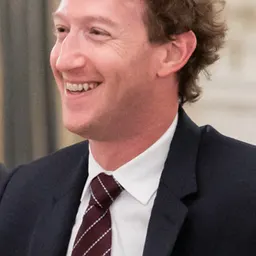
Life timeline of Mark Zuckerberg
Technology entrepreneur and co-founder of Facebook and Meta.
Education
Around 2000 – 2002
Studied at Phillips Exeter and captained the fencing team
At Phillips Exeter, Zuckerberg pursued mathematics, science, Latin and classical studies and served as captain of the fencing team. He graduated before entering Harvard in 2002. Source: Harvard Gazette and The New Yorker.
Around 2001 – 2002
Created the Synapse Media Player
Also in Work
As a high-school senior, Zuckerberg and a friend created Synapse, a music player that used machine-learning ideas to learn a listener's preferences. PC Magazine noticed the project, and AOL and Microsoft reportedly explored buying it and recruiting him. Source: Harvard Gazette and The New Yorker.
Sept 2002 – 2005
Attended Harvard University and studied computer science
Also in Location
Zuckerberg entered Harvard in the fall of 2002 as a member of the Class of 2006 and studied computer science. He did not complete the degree at the time, leaving Cambridge as Facebook grew. Source: Harvard Gazette and Meta's 2026 proxy statement.
Created and launched Facemash
Also in Work
In late October 2003, Zuckerberg built Facemash by pulling student photographs from Harvard house directories and inviting visitors to compare them. The site drew hundreds of visitors and tens of thousands of image votes within days but triggered immediate privacy and campus concerns. Source: The Harvard Crimson.
Career
Declined early recruiting interest from AOL and Microsoft
Also in Education
After Synapse attracted attention, Zuckerberg did not take the reported job opportunities from AOL or Microsoft and instead proceeded to college. The decision kept him on an academic path that led to Harvard. Source: Harvard Gazette and The New Yorker.
Launched TheFacebook from Harvard
Also in Work
On 4 February 2004, Zuckerberg and fellow Harvard students launched TheFacebook, initially for Harvard students. The service quickly expanded beyond Harvard and became the foundation of the company later renamed Meta. Source: Harvard Gazette and CNN's Facebook chronology.
Moved to Palo Alto to build Facebook
Also in Location · Work
After his sophomore year, Zuckerberg and colleagues moved to Palo Alto, California, to work on Facebook. Harvard accounts say he initially intended to return to college, but Facebook's rapid growth led him to devote his full attention to the company. Source: Harvard Gazette and CNN's Facebook chronology.
Facebook reached one million users
Also in Work
By December 2004, Facebook had reached one million users. The milestone demonstrated that the campus network had grown far beyond its original Harvard audience within its first year. Source: CNN's Facebook chronology.
Left Harvard as Facebook became his full-time focus
Also in Education · Location
Harvard records say Zuckerberg left Cambridge in 2005 for Silicon Valley rather than completing the Class of 2006 programme. He had originally expected to return, but Facebook's success changed that plan. Source: Harvard Gazette.
Changed News Feed controls after intense user backlash
Also in Work
Soon after Facebook introduced News Feed, users protested the way activity was surfaced. Zuckerberg acknowledged the strong reaction, and Facebook added additional privacy controls, an early example of changing a major product after user pressure. Source: Facebook company announcement.
Opened Facebook registration beyond schools and workplaces
Also in Work
On 26 September 2006, Facebook opened registration to anyone with a valid email address who met its age requirements, while retaining regional networks and privacy controls. The decision transformed the service from a largely institutional network into a general social platform. Source: Facebook company announcement.
Launched Facebook Platform at the first F8 conference
Also in Work
On 24 May 2007, Zuckerberg introduced Facebook Platform at F8, allowing outside developers to build applications that integrated deeply with Facebook. The launch included dozens of development partners and helped turn Facebook from a website into a broader software ecosystem. Source: Facebook company announcement.
Named Time's Person of the Year
In December 2010, Time selected Zuckerberg as Person of the Year, citing Facebook's extraordinary reach and impact. Reuters noted he was 26 and that Facebook then had more than 500 million users. Source: Reuters.
Agreed to acquire Instagram
Also in Finance · Work
In April 2012, Zuckerberg announced that Facebook would acquire Instagram for about $1 billion in cash and stock and said the service would continue to be built independently rather than simply absorbed into Facebook. The deal became one of Facebook's most consequential product acquisitions. Source: Wired.
Facebook completed its initial public offering
Also in Finance
Facebook began public trading on 18 May 2012 at an offering price of $38 per share. The IPO raised about $16 billion and turned Zuckerberg's company into one of the most valuable newly public technology firms of its era, though trading was marred by technical problems and an early stock decline. Source: contemporary market reporting and IPO records.
Agreed to acquire WhatsApp
Also in Finance · Work
In February 2014, Facebook agreed to buy WhatsApp in a transaction initially valued at about $19 billion, placing the fast-growing global messaging service under Zuckerberg's company. The acquisition substantially expanded Facebook's position in mobile messaging. Source: Reuters.
Agreed to acquire Oculus and make virtual reality a long-term bet
Also in Finance · Work
On 25 March 2014, Facebook agreed to buy Oculus VR for about $2 billion. Zuckerberg framed virtual reality and augmented reality as potential next-generation computing platforms, beginning the strategic commitment that later became central to Meta's identity. Source: Reuters.
Returned to Harvard for an honorary degree and commencement address
Also in Education
On 25 May 2017, Zuckerberg returned to Harvard as commencement speaker and received an honorary Doctor of Laws degree. He spoke about building a world in which people have a sense of purpose, nearly 12 years after leaving college to build Facebook. Source: Harvard Gazette and Reuters.
Publicly responded to the Cambridge Analytica data scandal
Also in Legal & Public Scrutiny
In March 2018, after revelations that Cambridge Analytica had obtained data tied to tens of millions of Facebook users, Zuckerberg called the episode a breach of trust and said Facebook had a responsibility to protect users' data. The scandal became one of the defining crises of his leadership. Source: Reuters/SBS coverage and Time.
10 Apr 2018 – 11 Apr 2018
Testified before US Congress over privacy, data use and platform responsibility
Also in Legal & Public Scrutiny
On 10 and 11 April 2018, Zuckerberg testified in lengthy Senate and House hearings following the Cambridge Analytica scandal. He apologised for Facebook's failures, answered questions about privacy and advertising, and faced sustained scrutiny over the company's business model and responsibilities. Source: Reuters and congressional-hearing coverage.
Accepted a record $5 billion FTC privacy settlement for Facebook
Also in Legal & Public Scrutiny · Finance
In July 2019, Facebook agreed to pay a $5 billion Federal Trade Commission penalty over privacy practices. The settlement also imposed new governance and compliance requirements, including quarterly privacy certifications by Zuckerberg and other executives. Source: reporting on the FTC settlement.
Rebranded Facebook the company as Meta and made the metaverse the strategic focus
Also in Work
On 28 October 2021, Zuckerberg announced that Facebook Inc. would become Meta, presenting the metaverse as the next major computing and social platform. The corporate rebrand separated the parent company's identity from the Facebook app and formalised a very large investment in virtual and augmented reality. Source: Meta's Connect presentation and contemporaneous coverage.
Announced Meta's first major mass layoff and took responsibility for overexpansion
Also in Finance
On 9 November 2022, Zuckerberg announced that Meta would cut about 11,000 jobs, roughly 13% of its workforce. He said he had overestimated how permanently the pandemic-era shift toward e-commerce would accelerate online growth and took responsibility for the decision to expand too aggressively. Source: contemporaneous reporting.
Declared a 'year of efficiency' and planned another major workforce reduction
Also in Finance
In March 2023, Meta announced plans to eliminate about 10,000 additional roles and close thousands of open positions as Zuckerberg pursued a 'year of efficiency'. The restructuring reduced management layers and marked a sharp turn from the company's earlier rapid hiring. Source: reporting summarised in Meta's company history.
Launched Threads as Meta's text-focused social network
Also in Work
Meta launched Threads on 5 July 2023 as a text-based social service tied closely to Instagram. Zuckerberg was highly visible in the launch, and the app passed 100 million sign-ups within five days, although early engagement later fell from its initial peak. Source: Meta product history and public usage reporting.
Ended Meta's US third-party fact-checking programme in favour of Community Notes
Also in Legal & Public Scrutiny · Work
In January 2025, Meta said it would scrap its US third-party fact-checking system and move toward a Community Notes model for organic content. The change represented a major shift in Zuckerberg's approach to platform moderation and political speech. Source: Reuters.
Made a $14.3 billion Scale AI investment and recruited Alexandr Wang for superintelligence work
Also in Finance · Work
In June 2025, Meta invested $14.3 billion for a 49% stake in Scale AI. A central strategic outcome was that Scale CEO Alexandr Wang joined Meta to play a leading role in Zuckerberg's new superintelligence effort, signalling a more aggressive push to compete at the frontier of AI. Source: Reuters.
Committed hundreds of billions of dollars to AI data-centre infrastructure
Also in Finance · Work
In July 2025, Zuckerberg said Meta would invest hundreds of billions of dollars in large AI data centres to support its pursuit of superintelligence. He identified projects including Prometheus and Hyperion and argued that Meta's advertising business could finance the scale of investment. Source: Reuters.
Launched Muse, Meta's personal AI agent
Also in Work
On 8 September 2026, Meta launched Muse in the United States, an AI agent designed to carry out tasks across connected apps such as email, calendars, shopping and payments. Meta presented it as an early product expression of Zuckerberg's 'personal superintelligence' vision, while Reuters reported that the launch followed additional security work after an earlier delay. Source: Meta and Reuters.
Presented Muse integrations and new AI and VR glasses at Connect 2026
Also in Work
At Connect 2026 on 23 September, Zuckerberg demonstrated new Muse features and Meta announced plans to bring Muse to AI glasses. Meta also introduced lightweight Meta VR Glasses, Ray-Ban Meta Audio, a new Ray-Ban Meta generation and other wearable updates, showing how Zuckerberg's AI and spatial-computing strategies had converged around glasses. Source: Meta.
Legal & Public Scrutiny
Shut down Facemash and apologised after privacy backlash
Also in Work
Zuckerberg shut down Facemash after criticism from students and Harvard groups over the use of photographs and privacy. He apologised, making this an early documented setback involving the social use of personal data. Source: The Harvard Crimson.
Other life moments
Jul 2004 – present
Leading Facebook and Meta
Meta's 2026 proxy statement says Zuckerberg has been founder and chief executive since 2004 and a director since 2004. The same filing identifies him as the company's largest and controlling shareholder, making this the central ongoing professional role of his adult life. Source: Meta 2026 proxy statement filed with the SEC.
Philanthropy
Pledged $100 million to Newark public schools
Also in Finance
In September 2010, Zuckerberg announced a $100 million commitment to improve public education in Newark, New Jersey. The pledge became one of his first very large public philanthropic commitments. Source: Reuters.
Launched the Chan Zuckerberg Initiative
Also in Finance · Work
On 1 December 2015, Zuckerberg and Chan announced the Chan Zuckerberg Initiative after the birth of Max. They also stated an intention to give 99% of their Facebook shares over their lifetimes to advance work in areas such as education, science and community. Source: Chan Zuckerberg Initiative and Time.
Committed $3 billion toward long-term disease research
Also in Finance · Work
In September 2016, Zuckerberg and Chan announced that CZI would commit $3 billion over ten years toward the long-term goal of curing, preventing or managing disease. The plan made biomedical science a core pillar of their philanthropy. Source: Time and Chan Zuckerberg Initiative.
Location
2017 – 2017
Set a personal challenge to visit every US state he had not yet visited
Also in Work
For his 2017 personal challenge, Zuckerberg said he would visit and meet people in every US state where he had not previously spent time, amounting to roughly 30 states. The project became a year-long listening tour focused on communities, work and social change. Source: Zuckerberg's public challenge as reported at the time.