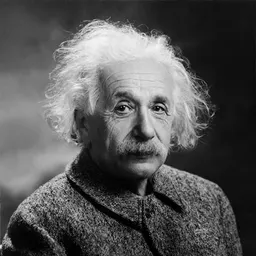
Life timeline of Albert Einstein
Physicist who developed the theories of relativity and helped shape modern physics.
Education
1895 – 1896
Completed secondary school at the cantonal school in Aarau
Also in Location
Einstein attended the cantonal school in Aarau, Switzerland, in 1895-1896, completing the schooling needed for admission to the Zurich Polytechnic.
Failed the Swiss Federal Polytechnic entrance examination on his first attempt
In 1895 Einstein sat the entrance examination for the Swiss Federal Polytechnic in Zurich. He did very well in mathematics and physics but did not pass the general examination, so he completed further secondary schooling before applying again.
1896 – 1900
Studied mathematics and physics at the Swiss Federal Polytechnic in Zurich
Also in Location
Einstein studied mathematics and physics at the Federal Polytechnic School, now ETH Zurich, from 1896 to 1900 and earned a teaching diploma. ETH Zurich identifies him as both an alumnus and later professor.
Citizenship
Renounced Württemberg citizenship and became stateless
Einstein gave up his Württemberg/German citizenship in 1896. He remained without a national citizenship until acquiring Swiss citizenship in 1901.
Became a Swiss citizen
Einstein acquired Swiss citizenship in February 1901 and retained it for the rest of his life. He was subsequently found medically unfit for Swiss military service.
Renounced German citizenship after the Nazi takeover
Also in Public Life · Location
After returning to Europe but refusing to re-enter Nazi Germany, Einstein landed in Antwerp on 28 March 1933 and surrendered his German passport at the consulate, formally renouncing German citizenship.
Became a United States citizen while retaining Swiss citizenship
Also in Location
Einstein became a United States citizen in 1940. He retained the Swiss citizenship he had held since 1901.
Career
1900 – 1902
Struggled to secure a permanent teaching or academic job
Also in Finance
After graduation Einstein spent roughly two years applying unsuccessfully for teaching posts. Contemporary biographical accounts describe this as a financially precarious period in which he relied on family support and private tutoring before securing patent-office work.
Graduated with a teaching diploma in mathematics and physics
Also in Education
Einstein completed the Federal Polytechnic's mathematics-and-physics teaching programme in 1900. ETH Zurich records that he obtained the teaching diploma after studying there from 1896 to 1900.
1902 – 1904
Developed early statistical-mechanics research while working in Bern
Also in Scientific Work · Work
Alongside his patent-office job, Einstein published papers in 1902-1903 that treated thermodynamic and atomic phenomena statistically, extending a line of research that fed into his later work on Brownian motion.
Jun 1902 – 1909
Worked at the Swiss Patent Office in Bern
Also in Location
Einstein began work in 1902 at the Swiss Federal Patent Office in Bern as a technical examiner. The post became permanent in 1903 and provided stable employment during the years in which he developed his most famous early physics.
Jul 1912 – 1914
Professor of theoretical physics at ETH Zurich
Also in Education · Location
Einstein returned to his alma mater, ETH Zurich, in 1912 as a full professor of theoretical physics and remained there until moving to Berlin in 1914.
Retired from his formal Institute for Advanced Study post
Nobel's biographical record states that Einstein retired from his formal Princeton post in 1945, though he continued scientific work and public advocacy in the years that followed.
Scientific Work
Published his first scientific paper on capillarity
Also in Work
Einstein's first published scientific paper dealt with capillary attraction and appeared in Annalen der Physik in 1901. It marked the start of his published research career.
Submitted the light-quantum and photoelectric-effect paper
Also in Work
On 17 March 1905 Einstein sent the paper that proposed light quanta and used the idea to explain the photoelectric effect. This work later became central to the Nobel committee's stated reason for his physics prize.
Submitted his doctoral dissertation on molecular dimensions
Also in Education
On 30 April 1905 Einstein submitted his dissertation, 'A New Determination of Molecular Dimensions,' to the University of Zurich. The thesis used molecular-scale reasoning to determine quantities such as molecular dimensions and Avogadro-related values.
Submitted the Brownian-motion paper
Also in Work
The journal received Einstein's Brownian-motion paper on 11 May 1905. It gave a quantitative account of suspended-particle motion that supported the molecular-atomic picture of matter.
Submitted the special-relativity paper
Also in Work
On 30 June 1905 Einstein's paper 'On the Electrodynamics of Moving Bodies' was received by Annalen der Physik. It formulated special relativity by reconciling mechanics with electromagnetic theory without an ether frame.
Submitted the mass-energy equivalence paper
Also in Work
On 27 September 1905 Einstein sent a short follow-up paper deriving the equivalence of mass and energy from special relativity, the result later popularly associated with E=mc².
Formulated the equivalence principle as a route toward a theory of gravitation
Also in Work
In 1907 Einstein identified the equivalence of uniform acceleration and a homogeneous gravitational field as a key conceptual step beyond special relativity. This became a foundation of the later general theory of relativity.
Completed the field equations of general relativity
Also in Work
In November 1915 Einstein presented a sequence of communications to the Prussian Academy, culminating on 25 November with the generally covariant field equations of general relativity.
Around 1920 – 18 Apr 1955
Continued the search for a unified field theory
Also in Work
From the later part of his European career through his Princeton years, Einstein repeatedly pursued a unified geometrical theory that could bring gravitation and electromagnetism, and eventually fundamental physics more broadly, into one framework. The programme remained unfinished at his death.
1924 – 1925
Developed Bose-Einstein statistics and the prediction of a new quantum state
Also in Work
After receiving Satyendra Nath Bose's work on quantum statistics, Einstein helped bring it to publication and extended the method to a gas of material particles in 1924-1925. The work established Bose-Einstein statistics and predicted the condensation phenomenon later called Bose-Einstein condensation.
1926 – Around 1930
Worked with Leo Szilard on a refrigerator with no moving mechanical parts
Also in Work
Einstein and Leo Szilard collaborated on refrigeration inventions in the late 1920s, producing patented designs intended to improve safety by avoiding conventional moving mechanical components.
Developed the Einstein-Rosen bridge solution with Nathan Rosen
Also in Work
In 1935 Einstein and Nathan Rosen published a general-relativity construction later known as the Einstein-Rosen bridge, an early mathematical treatment of a bridge between regions of spacetime.
Published the Einstein-Podolsky-Rosen challenge to quantum mechanics
Also in Work
In 1935 Einstein, Boris Podolsky and Nathan Rosen published the EPR paper, arguing that the quantum-mechanical description appeared incomplete under assumptions about locality and physical reality. It became one of the most influential critiques in the foundations of quantum theory.
Awards and Recognition
Received the doctorate from the University of Zurich
Also in Education
Einstein was formally awarded his doctorate by the University of Zurich on 15 January 1906 after the 1905 approval of his dissertation.
Solar-eclipse observations confirmed the predicted deflection of starlight
Also in Scientific Work
Measurements made during the 29 May 1919 solar eclipse by British expeditions supported the general-relativistic prediction that the Sun's gravity deflects starlight. The result was the first major external-team test of the theory and propelled Einstein to extraordinary public fame.
Was awarded the 1921 Nobel Prize in Physics
Also in Scientific Work
The Nobel Foundation awarded Einstein the 1921 Nobel Prize in Physics, with the award made in 1922 after the 1921 committee had deferred the prize. The citation recognized his services to theoretical physics, especially his discovery of the law of the photoelectric effect.
Public Life
1914 – 1918
Publicly opposed militarism during the First World War
During the First World War Einstein became publicly identified with anti-militarist and internationalist positions, setting him apart from many prominent German academics who supported the war effort. A retrospective based on his political writings traces this stance from 1914 onward.
2 Apr 1921 – Apr 1921
First major visit to the United States and fundraising for the Hebrew University
Also in Location · Work
Einstein arrived in New York on 2 April 1921 and spent several weeks lecturing and attending public events in the United States. He travelled with Chaim Weizmann and used his growing fame to support fundraising for the planned Hebrew University of Jerusalem.
Signed the Einstein-Szilard warning letter to President Franklin D. Roosevelt
Also in Scientific Work
On 2 August 1939 Einstein signed the letter drafted with Leo Szilard's involvement warning President Franklin D. Roosevelt that uranium might make extremely powerful bombs possible and urging attention to nuclear research amid fears of a German programme.
1945 – 18 Apr 1955
Became a leading advocate of world government after the Second World War
After the Second World War Einstein became a prominent advocate of international political structures strong enough to prevent future wars, and Nobel's biography describes him as a leading figure in the World Government Movement.
Declined the presidency of Israel
After the death of Chaim Weizmann, Einstein was offered the presidency of Israel. He declined; a surviving letter dated 21 November 1952 explains that he did not consider himself suited to the personal and official demands of the office and also reflects political reservations.
Signed the Russell-Einstein Manifesto calling for action against nuclear war
Also in Scientific Work
In the final days of his life Einstein added his name to the appeal developed with Bertrand Russell warning of the existential dangers of nuclear weapons and urging peaceful resolution of international conflict. The Russell-Einstein Manifesto was publicly issued on 9 July 1955, after Einstein's death.
Other life moments
1914 – 1933
Berlin years: scientific leadership
Einstein moved to Berlin in 1914 to join the Prussian Academy of Sciences and take up senior academic responsibilities. Nobel's biography records that he became a German citizen again in 1914 and remained based in Berlin until 1933.
1933 – 1945
Princeton years at the Institute for Advanced Study
Einstein emigrated to the United States in 1933 and took up a permanent research position at the Institute for Advanced Study in Princeton, New Jersey. Nobel's biography notes the Princeton appointment and clarifies that the formal association was with the Institute for Advanced Study.